503A vs 503B Compounding Pharmacies: What the Difference Means for You
If you have looked into compounded medication, you have probably seen the labels “503A” and “503B”. They sound like paperwork codes, but they describe two different kinds of compounders, overseen in two different ways, serving two different needs. Knowing which one you are dealing with tells you who inspects it, whether your prescription is made for you by name, and what questions to ask. This guide explains both in plain language.
This article is educational and is not medical advice. Talk with your prescriber or pharmacist about your own situation.
Where the names come from
“503A” and “503B” are two sections of the Federal Food, Drug, and Cosmetic Act, the main law the U.S. Food and Drug Administration (FDA) enforces. Section 503A covers traditional compounding by a licensed pharmacist in a state-licensed pharmacy, or by a licensed physician. Section 503B was added by the Drug Quality and Security Act of 2013 and created a new category called the “outsourcing facility”. That law followed a 2012 outbreak of fungal meningitis traced to contaminated injections from a compounder in Massachusetts, and it was written to give FDA more direct oversight of large-scale compounding.
One thing both sections share: compounded drugs are not FDA-approved. FDA does not review a compounded medication for safety, effectiveness or quality before it is dispensed, the way it does for a manufactured drug. Each section instead sets conditions a compounder must meet in exchange for being exempt from certain requirements that apply to drug manufacturers.
503A: the traditional compounding pharmacy
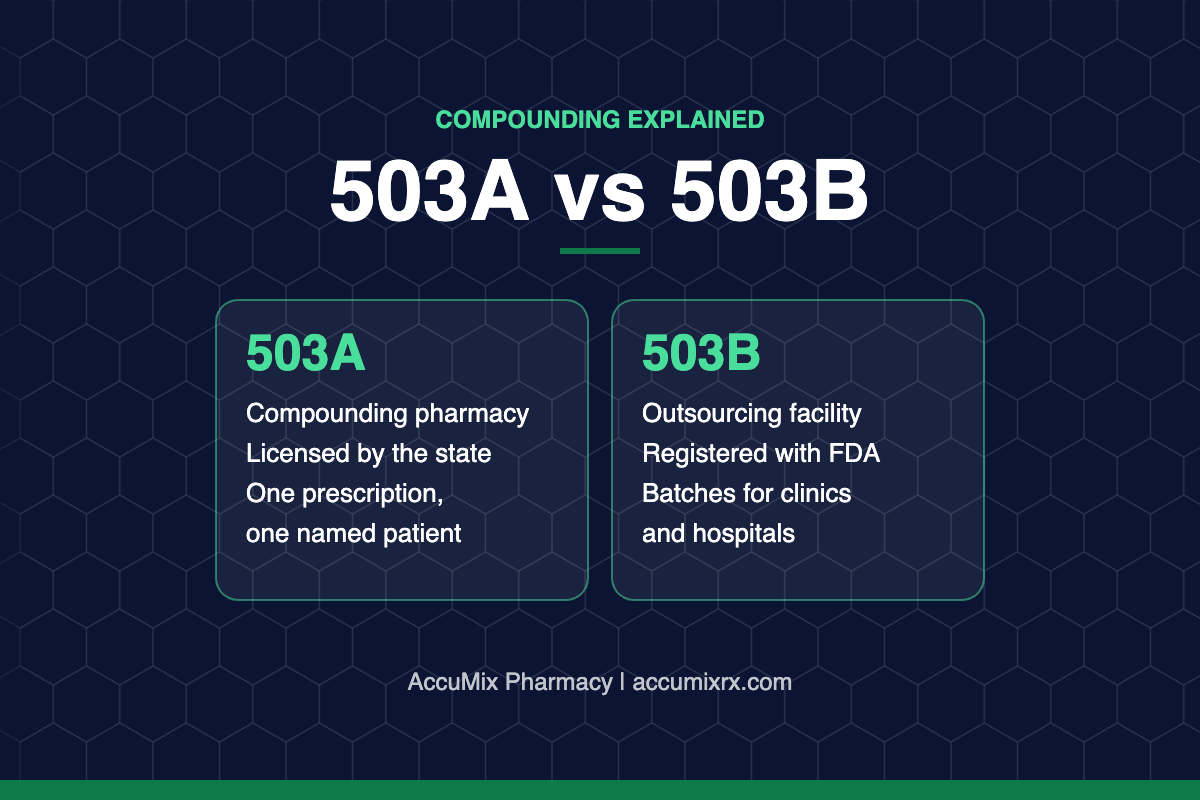
A 503A pharmacy is what most people picture when they hear “compounding pharmacy”. It is licensed by the state board of pharmacy, and the state has primary responsibility for its day-to-day oversight. FDA can still conduct surveillance and for-cause inspections, but the board of pharmacy is the regulator a 503A pharmacy answers to most often.
The defining feature of 503A is the prescription. Under federal law, a 503A pharmacy compounds a medication based on a valid prescription for an identified individual patient. The preparation is made for one named person, after the prescriber has decided that person needs it. A 503A pharmacy may prepare limited quantities ahead of time in anticipation of prescriptions it regularly receives, but it cannot run as a factory that fills shelves and sells to whoever asks.
Federal law also sets limits on what a 503A pharmacy can compound. The active ingredients must either be components of FDA-approved drugs, have a monograph in the United States Pharmacopeia, or appear on an FDA list of bulk substances allowed for 503A compounding. The pharmacy cannot compound a drug that FDA has withdrawn as unsafe or ineffective, cannot “regularly or in inordinate amounts” make copies of commercially available products, and must follow the quality standards of the United States Pharmacopeia (USP), such as chapter 795 for non-sterile preparations and chapter 797 for sterile ones.
AccuMix Pharmacy is a 503A pharmacy. Every preparation we make is for a specific patient with a prescription from that patient’s licensed prescriber. You can read more about how that works in our earlier article What is a compounding pharmacy?
503B: the outsourcing facility
A 503B outsourcing facility registers directly with FDA and is inspected by FDA on a risk-based schedule. It compounds under current good manufacturing practice (CGMP), the same general standard that applies to drug manufacturers. It must report to FDA what it makes and any adverse events it learns of, and its labels must carry the statement “This is a compounded drug”. An outsourcing facility does not have to be a licensed pharmacy, although its compounding must be done by or under the direct supervision of a licensed pharmacist.
The biggest practical difference is who the medication is for. Under section 503B, an outsourcing facility “may or may not” obtain prescriptions for identified individual patients. That means it can compound larger batches and supply them to hospitals, clinics and physician offices to keep on hand, without a named patient attached to each vial. That is the “outsourcing” in the name: a hospital that no longer compounds a certain IV preparation in-house can outsource it to a 503B facility.
FDA publishes a list of registered outsourcing facilities on its website, updated regularly. Registration is a legal requirement, not an FDA endorsement of any facility’s products.
Side by side
| Question | 503A compounding pharmacy | 503B outsourcing facility |
|---|---|---|
| Who is the main regulator? | State board of pharmacy, with FDA surveillance and for-cause inspections | FDA, with inspections on a risk-based schedule |
| Is a patient-specific prescription required? | Yes, for an identified individual patient (limited anticipatory compounding is allowed) | No; it may or may not obtain patient-specific prescriptions |
| Which quality standard applies? | USP chapters such as 795 and 797, and state pharmacy rules | Current good manufacturing practice (CGMP) |
| Must it register with FDA? | No (it is licensed by the state) | Yes, with annual re-registration and fees |
| Must it report adverse events to FDA? | Not required by section 503A; state rules vary | Yes |
| Typical customer | An individual patient, by prescription | Hospitals, clinics and practices buying stock |
| Are its products FDA-approved? | No | No |
Why both kinds exist
They answer different needs. A patient who cannot swallow tablets, is allergic to a dye in a commercial product, or needs a strength that is not manufactured is served by a 503A pharmacy that can make one preparation for one person. A hospital emergency department that needs a steady supply of a ready-to-use syringe for any patient who comes through the door is served by a 503B facility that can make that product in bulk under manufacturing-style controls.
Some of the therapy areas we work in illustrate the 503A side well. Allergy immunotherapy is mixed to match one patient’s test results, so by its nature it is patient-specific. Compounded topical and hormone preparations are made at the strength and in the base a prescriber chooses for an individual. FDA itself notes that compounding may be appropriate when a patient “cannot be treated with an FDA-approved medication”, and that compounded drugs should be used only when an approved product cannot meet the patient’s medical need.
What this means when you are a patient
If your prescriber writes a compounded prescription for you, it will almost always be filled by a 503A pharmacy, because a prescription for a named patient is exactly what 503A is built around. If you receive a compounded injection in a clinic or hospital, it may have come from a 503B facility’s stock. Either way, you have the right to ask where the medication was made and under which category.
Useful questions for any compounder:
- Is this pharmacy licensed by my state’s board of pharmacy? Most boards have a public license lookup, and a pharmacy that ships across state lines must be licensed in the patient’s state as well.
- Is this medication being made for me by name, or from stock?
- What testing is done on sterile preparations, and can I see a certificate of analysis?
- What is the beyond-use date, and how should I store the medication?
- Can I speak with a pharmacist if I have a question or a reaction?
If you ever have a problem with a compounded medication, tell your prescriber and the pharmacy first. Problems can also be reported to FDA through its MedWatch program.
What this means when you are a prescriber or clinic
Practices sometimes ask a 503A pharmacy for “office stock”: a supply of a compounded product to keep on hand for patients who have not yet been identified. Under federal law that is the role of a 503B outsourcing facility, not a 503A pharmacy. A 503A pharmacy fills patient-specific prescriptions, and some states add their own rules on top of the federal ones. If your practice needs stock for in-office use, FDA’s list of registered outsourcing facilities is the place to start. If your patients need individualized preparations, a 503A pharmacy like AccuMix is the right partner, and our Providers & Platforms page explains how prescriptions reach us.
How AccuMix operates as a 503A pharmacy
AccuMix Pharmacy, LLC is a 503A sterile and non-sterile compounding pharmacy in Elmhurst, Illinois. We are licensed by the Illinois Department of Financial and Professional Regulation and by the boards of pharmacy of the states we ship to; the current list is on our States We Serve page. Nothing is sold through our website: every medication requires a prescription from a licensed prescriber and is compounded for the individual patient named on it. Sterile preparations are made in ISO-classified cleanrooms under USP chapter 797; every sterile batch is tested for sterility and endotoxins, and potency is tested on a regular schedule and whenever the source of an active ingredient changes. A certificate of analysis is available on request. Our website is LegitScript-certified, and a pharmacist is available to answer questions during business hours and on call after hours.
Frequently asked questions
Is a 503B facility safer than a 503A pharmacy?
They are regulated differently, not ranked. 503B facilities follow manufacturing-style CGMP and are inspected by FDA because they make larger batches without patient-specific prescriptions. 503A pharmacies follow USP standards and state pharmacy rules because they make individual preparations. Both must be run properly to be safe, and neither category’s products are FDA-approved.
Can a 503A pharmacy sell compounded medication to my doctor’s office to keep on hand?
Under section 503A, compounding must be based on a prescription for an identified individual patient. Supplying stock without named patients is what section 503B outsourcing facilities were created for. Some states have additional rules, so a prescriber should check with the state board of pharmacy and the pharmacy itself.
How do I check whether a compounder is a registered 503B facility?
FDA keeps a public list of registered outsourcing facilities on fda.gov, updated regularly. If a facility is not on the list, it is not a 503B outsourcing facility. For a 503A pharmacy, check the license with the state board of pharmacy.
Does “compounded” mean the same as “generic”?
No. A generic drug is an FDA-approved product shown to be equivalent to a brand-name drug and made by a manufacturer. A compounded medication is prepared by a pharmacy or outsourcing facility for a specific need and is not FDA-approved. Our article on the forms compounded medications come in covers the common dosage forms.
Sources and review
Last reviewed October 22, 2026. Written by the AccuMix Pharmacy team and reviewed by a licensed pharmacist.
- U.S. Food and Drug Administration, FD&C Act Provisions that Apply to Human Drug Compounding (sections 503A and 503B compared).
- U.S. Food and Drug Administration, Compounding and the FDA: Questions and Answers (content current as of September 16, 2025).
- U.S. Food and Drug Administration, Registered Outsourcing Facilities (list updated September 30, 2026).
- U.S. Food and Drug Administration, MedWatch: The FDA Safety Information and Adverse Event Reporting Program.
- Centers for Disease Control and Prevention, Multistate Outbreak of Fungal Infection Associated with Injection of Methylprednisolone Acetate Solution from a Single Compounding Pharmacy, 2012 (MMWR).
- Drug Quality and Security Act, Public Law 113-54 (2013), Title I (Compounding Quality Act).
Questions about a compounded prescription? Call AccuMix Pharmacy at 866-817-5303, Monday to Friday, 8:30 AM to 5:30 PM Central, or send us a message.