Questions to Ask Before Choosing a Compounding Pharmacy
A compounded medication is made for one patient, from a prescription, by a pharmacist. Because it is prepared this way rather than coming off a manufacturing line, the pharmacy that makes it matters more than it does for a shelf product. Two pharmacies can fill the same prescription with very different ingredients, equipment, testing and record-keeping behind it.
Here are nine questions a patient, caregiver or prescriber can ask before choosing a compounding pharmacy, why each matters, and where the answers can be checked. At the end we say how AccuMix Pharmacy answers them.
This article is educational and is not medical advice. Talk with your prescriber or pharmacist about your own situation.
First, what a compounding pharmacy is and is not
Compounded medications are not reviewed or approved by the FDA, which states that it does not verify their safety, effectiveness or quality before they are dispensed. FDA also says compounded drugs should be used when a patient’s needs cannot be met by an FDA-approved medicine, for example a patient allergic to a dye in the commercial product or a child who needs a liquid instead of a tablet. Day-to-day oversight of a traditional compounding pharmacy sits with the state board of pharmacy in each state where it is licensed.
With no FDA approval behind the product, the pharmacy’s own licensing, sourcing, process and testing are what stand behind it. That is why the questions below matter.
1. Is the pharmacy licensed in my state?
A pharmacy must hold a license from the board of pharmacy in the state where it operates, and usually a separate non-resident license for every other state it ships into. FDA’s BeSafeRx guidance tells patients to confirm a pharmacy is licensed both in their own state and in the state where the pharmacy is located, and to look it up in the state board’s license database. If the pharmacy is not listed, FDA’s advice is not to use it.
Ask for the pharmacy’s license number and the name of its pharmacist-in-charge. For an Illinois pharmacy, the license can be checked on the Illinois Department of Financial and Professional Regulation’s license lookup.
2. Is it a 503A pharmacy or a 503B outsourcing facility?
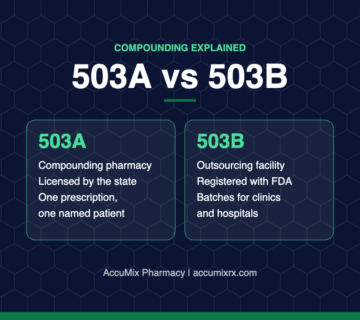
Federal law recognizes two kinds of compounders. A 503A pharmacy compounds for an identified patient on a prescription and is overseen mainly by state boards. A 503B outsourcing facility registers with FDA, follows manufacturing-style quality rules, and can compound larger batches for clinics and hospitals without a patient-specific prescription. Neither is better for every situation; they serve different needs. Our article 503A vs 503B compounding pharmacies explains the difference in detail.
For a prescription written for you by name, you will usually be working with a 503A pharmacy.
3. Who inspects the pharmacy, and is it accredited?
Every licensed pharmacy is inspected by its state board. Accreditation goes a step further: an outside organization reviews the pharmacy’s policies, training, facility and records against the United States Pharmacopeia (USP) compounding standards. Two programs are widely recognized in the United States:
- PCAB accreditation, run by the Accreditation Commission for Health Care (ACHC), with separate standards for non-sterile compounding (based on USP <795>), sterile compounding (USP <797>) and hazardous drug handling (USP <800>).
- NABP Compounding Pharmacy Accreditation, run by the National Association of Boards of Pharmacy, a three-year accreditation that evaluates alignment with USP <795>, <797> and <800> and with the federal 503A requirements, and that requires an on-site inspection beforehand.
Both organizations publish directories of accredited pharmacies. Separately, LegitScript certifies pharmacy websites, checking that the business behind the site is licensed and operates lawfully; it is a website standard, not a compounding standard. An application in progress is a fair answer, as long as it is stated that way.
4. Where do the ingredients come from?
Under section 503A, the bulk drug substances a pharmacy compounds with must meet a USP or National Formulary monograph (or be a component of an FDA-approved drug, or appear on FDA’s list of permitted bulk substances), must come from a supplier registered with FDA, and must arrive with a valid certificate of analysis for each lot.
Ask whether the pharmacy buys its active ingredients from FDA-registered suppliers and whether it will show you the certificate of analysis for the lot used in your medication. For semaglutide, FDA has warned that salt forms such as semaglutide sodium and semaglutide acetate are different substances from the one in the approved products and that it knows of no lawful basis for using them in compounding. A pharmacy should be able to say exactly which substance it uses.
5. How is sterile compounding done, and what is tested?
Injections, eye preparations and anything else that enters the body past its natural barriers must be made under USP General Chapter <797>, which sets standards for personnel training, garbing, facilities, environmental monitoring and the storage and testing of finished preparations. The revised <795> and <797> chapters became official on November 1, 2023, so ask whether the pharmacy’s procedures follow the current versions.
Useful questions: Is sterile work done in an ISO Class 5 hood inside an ISO Class 7 cleanroom? Are finished sterile batches tested for sterility and bacterial endotoxins? How often is potency tested, and is it repeated when the source of an active ingredient changes? Will the pharmacy share the test results on request?
6. How are beyond-use dates set, and how should I store the medication?
A compounded medication carries a beyond-use date (BUD) rather than a manufacturer’s expiration date. The BUD is assigned by the pharmacy using the USP chapters, and it depends on the dosage form, how the preparation was made, whether it was tested, and how it is stored. Ask how the date on your label was set and what storage it assumes. For multi-dose injectable vials, FDA’s current guidance is to discard the vial within 28 days of first use. Our article What a beyond-use date means covers this in more depth.
7. Can I talk to a pharmacist?
FDA lists a licensed pharmacist who is available to answer your questions as one of the marks of a legitimate pharmacy, alongside a physical address and telephone number in the United States and a requirement for a prescription. For a compounded medication, counseling matters even more than usual: the dosage form may be unfamiliar, the measuring device may be different from what the pharmacy down the street hands out, and the storage rules may be stricter.
Ask how you reach a pharmacist during the day, what happens after hours, and whether written instructions come with the medication.
8. Does the pharmacy behave like a pharmacy?
FDA’s warning signs for an unsafe source include a website that sells medicine without a prescription, prices that seem too good to be true, unsolicited emails offering cheap medicine, and shipping from outside the United States. On compounded weight-management drugs in particular, FDA has told patients to fill prescriptions only at state-licensed pharmacies and has flagged telehealth marketing that claims a compounded drug is the same as an FDA-approved one. In 2026 it sent warning letters to telehealth companies over such claims.
A compounding pharmacy should require a prescription from a licensed prescriber for every preparation, should not promise results, and should say openly that compounded medications are not FDA-approved.
9. What happens after the prescription is filled?
Ask about turnaround time, how refrigerated items are packed and shipped, whether pickup or delivery is offered, what to do if a package arrives warm or damaged, how a recall or quality complaint is handled, and how to report a side effect. A good pharmacy has a plain answer to each of these before you need one.
How AccuMix Pharmacy answers these questions
AccuMix Pharmacy is a 503A sterile and non-sterile compounding pharmacy in Elmhurst, Illinois. It holds Illinois pharmacy license 054.022076 and non-resident licenses in 41 states and Washington, DC, with more applications in process; the current list is on our States We Serve page. Our pharmacist-in-charge is named, with his license number, on the About Us page.
Our website is LegitScript-certified, and our application for NABP accreditation was submitted in October 2026. We are members of the American College of Apothecaries, the Alliance for Pharmacy Compounding, PCCA and the American Pharmacists Association.
Active ingredients are purchased from FDA-registered suppliers and arrive with a certificate of analysis. Sterile preparations are made in ISO Class 5 workstations inside an ISO Class 7 cleanroom. Every sterile batch is tested for sterility and endotoxins; potency is tested regularly and whenever the source of an active ingredient changes. Certificates of analysis are available on request. Every preparation requires a prescription from a licensed prescriber; nothing is sold through this website. Our standard is 24 hours turnaround time, a pharmacist is available during business hours and on call after hours through the phone menu, and compounded medications are not FDA-approved, which we say on every product page.
Frequently asked questions
How do I check whether a compounding pharmacy is licensed?
Look it up in the license database of your state’s board of pharmacy, and in the database of the state where the pharmacy is located. FDA keeps a state-by-state list of these databases. If the pharmacy does not appear, do not use it.
Is an accredited compounding pharmacy required by law?
No. Licensing is required; accreditation is voluntary. Accreditation shows that an outside reviewer has checked the pharmacy against USP standards, which is useful information, but many well-run pharmacies are in the middle of the process or inspected only by their state board.
Should I expect a compounded medication to work the same as the brand product?
No one can promise that. Compounded medications are not reviewed by FDA for safety, effectiveness or quality, and FDA has objected to marketing that calls a compounded drug the same as an approved one. Your prescriber decides whether a compounded preparation is appropriate for you.
Sources and review
Last reviewed November 22, 2026. The regulatory points above were checked against these sources on that date. FDA policy on compounding changes often; this article will be updated when it does.
- FDA: Compounding and the FDA, Questions and Answers
- FDA guidance: Pharmacy Compounding of Human Drug Products Under Section 503A (June 2016)
- FDA BeSafeRx: Frequently Asked Questions and Locate a State-Licensed Online Pharmacy
- FDA: Concerns with Unapproved GLP-1 Drugs Used for Weight Loss (updated October 1, 2026)
- NABP Compounding Pharmacy Accreditation
- ACHC: PCAB Compounding Pharmacy Accreditation
- USP: Compounding chapters <795> and <797>, official November 1, 2023
- Illinois Department of Financial and Professional Regulation (license lookup)
Questions about a compounded prescription? Call AccuMix Pharmacy at 866-817-5303 (Monday to Friday, 8:30 AM to 5:30 PM Central) or send us a message.