
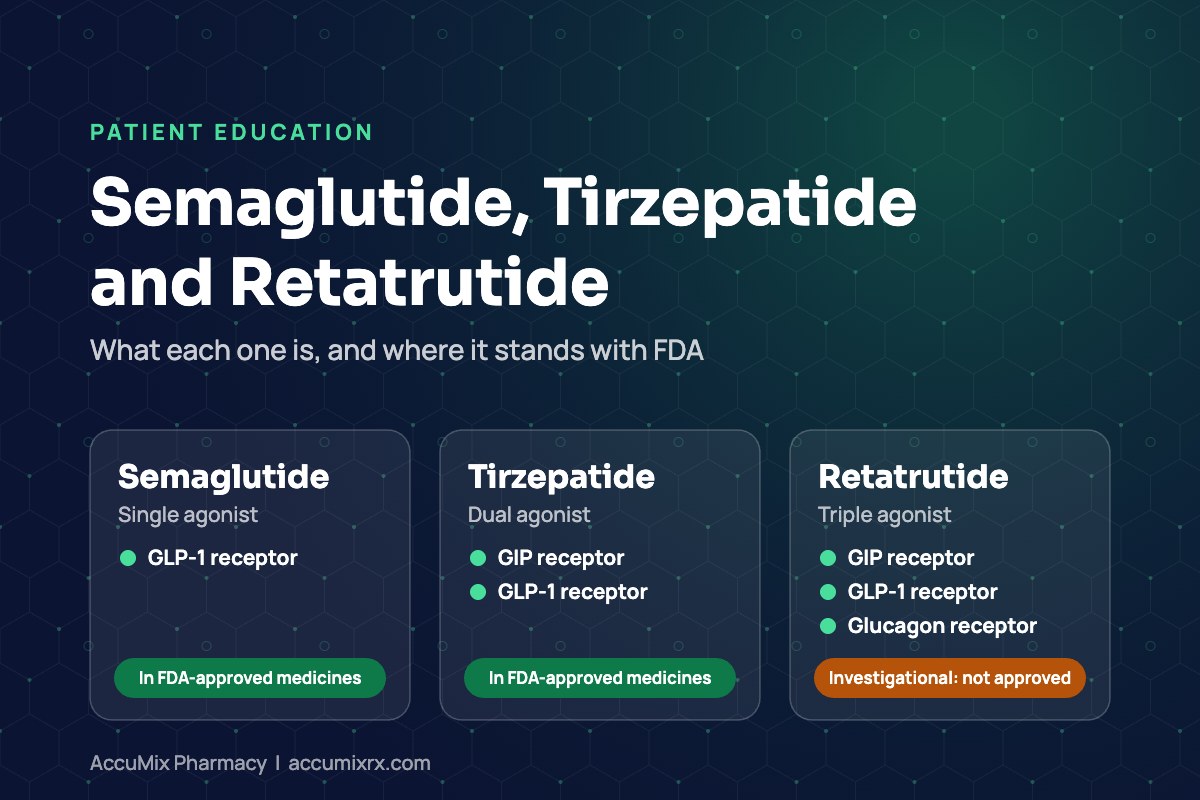
Semaglutide, Tirzepatide and Retatrutide: How They Differ
Semaglutide, tirzepatide and retatrutide are three of the most searched names in weight management. They are related, but they are not the same kind of medicine, and they are not at the same stage. Two are the active ingredients in FDA-approved drugs. The third is still in clinical trials. This guide explains what each one is, how it works and where it stands with FDA as of October 2026.
This article is for information and education only. It is not medical advice, and it is not an offer to sell or dispense any medication. Treatment decisions belong to you and a licensed clinician who knows your history.
At a glance
| Semaglutide | Tirzepatide | Retatrutide | |
|---|---|---|---|
| Type | GLP-1 receptor agonist | Dual GIP and GLP-1 receptor agonist | Triple GIP, GLP-1 and glucagon receptor agonist |
| Developed by | Novo Nordisk | Eli Lilly | Eli Lilly |
| FDA status | Active ingredient in FDA-approved medicines | Active ingredient in FDA-approved medicines | Not approved. Investigational. |
| U.S. brand names | Ozempic®, Wegovy®, Rybelsus® | Mounjaro®, Zepbound® | None |
| How it is given | Once-weekly injection or daily tablet, depending on the product | Once-weekly injection | Once-weekly injection in clinical trials |
| First FDA approval | 2017 | 2022 | None yet |
How these medicines work
After a meal, the gut releases hormones called incretins. They tell the pancreas to release insulin when blood sugar is up, slow the rate at which the stomach empties, and signal fullness to the brain. All three medicines are laboratory-made peptides that act on the receptors for these hormones.
- GLP-1 (glucagon-like peptide-1) slows stomach emptying, reduces appetite and supports insulin release when glucose is high.
- GIP (glucose-dependent insulinotropic polypeptide) is a second incretin. Its receptors are found in the pancreas, fat tissue and the brain.
- Glucagon is a hormone involved in how the body uses stored energy.
Semaglutide acts on one of these receptors, tirzepatide on two, and retatrutide on three. That is why they are often described as single, dual and triple agonists. Acting on more receptors does not make a medicine the right choice for a particular person. That depends on health history, other medications, side effects and what FDA has approved.
Semaglutide
Semaglutide is a GLP-1 receptor agonist made by Novo Nordisk. FDA first approved it in 2017. In the United States it is the active ingredient in:
- Ozempic®, a once-weekly injection approved for adults with type 2 diabetes.
- Rybelsus®, a daily tablet approved for adults with type 2 diabetes.
- Wegovy®, approved for chronic weight management together with diet and physical activity, and to lower the risk of major cardiovascular events in certain adults with heart disease. Wegovy is a once-weekly injection; FDA approved a once-daily Wegovy tablet in December 2025.
In the STEP 1 trial, adults with obesity or overweight and without diabetes who took semaglutide 2.4 mg weekly, alongside lifestyle changes, lost an average of 14.9% of their body weight over 68 weeks. The placebo group lost 2.4%.
Tirzepatide
Tirzepatide is made by Eli Lilly. It is a single molecule that activates both the GIP and GLP-1 receptors, so it is not strictly a “GLP-1”, although it is usually grouped with them. In the United States it is the active ingredient in:
- Mounjaro®, approved in 2022 for adults with type 2 diabetes.
- Zepbound®, approved in 2023 for chronic weight management and in 2024 for moderate to severe obstructive sleep apnea in adults with obesity.
Both are once-weekly injections. In the SURMOUNT-1 trial, adults without diabetes lost an average of 15.0%, 19.5% and 20.9% of their body weight at 72 weeks on the 5 mg, 10 mg and 15 mg doses. The placebo group lost 3.1%. In SURMOUNT-5, the only large trial to compare the two medicines directly, average weight loss at 72 weeks was 20.2% with tirzepatide and 13.7% with semaglutide.
Retatrutide
Retatrutide is an investigational medicine from Eli Lilly. It activates three receptors: GIP, GLP-1 and glucagon. In clinical trials it is given as a once-weekly injection. Retatrutide is not approved by FDA for any use.
Lilly is studying it in a Phase 3 program called TRIUMPH. Results the company has announced so far include:
- TRIUMPH-1 (2,339 adults with obesity or overweight, without diabetes): average weight loss at 80 weeks of 19.0%, 25.9% and 28.3% on the 4 mg, 9 mg and 12 mg doses.
- TRIUMPH-2 (adults with type 2 diabetes and obesity or overweight): 12.7% to 20.8% at 80 weeks, compared with 4.0% on placebo.
- TRIUMPH-3 (adults with severe obesity and cardiovascular disease): 21.6% and 22.6% at 80 weeks on the 9 mg and 12 mg doses, compared with 3.2% on placebo.
The most common side effects reported were nausea, diarrhea, constipation and vomiting, and more people stopped treatment because of side effects at the higher doses. Unusual skin sensations (dysesthesia) were also reported. In July 2026 Lilly said it plans to submit retatrutide to FDA in the first quarter of 2027. Until FDA has reviewed the full data and approved a product, the benefits and risks of retatrutide have not been established.
Can you get retatrutide today?
Only as a participant in a clinical trial. FDA states that retatrutide cannot be used in compounding under federal law, because it is not part of any FDA-approved drug and has not been found safe and effective for any condition. FDA has also warned companies that sell retatrutide online labeled “for research use only” or “not for human consumption”. The quality and contents of those products are unknown, and FDA urges consumers not to buy them.
AccuMix Pharmacy does not compound, dispense or sell retatrutide.
Trial results side by side
| Semaglutide | Tirzepatide | Retatrutide | |
|---|---|---|---|
| Trial | STEP 1 | SURMOUNT-1 | TRIUMPH-1 |
| Dose | 2.4 mg weekly | 15 mg weekly | 12 mg weekly |
| Length | 68 weeks | 72 weeks | 80 weeks |
| Average weight loss | 14.9% | 20.9% | 28.3% |
| Regulatory status | FDA-approved | FDA-approved | Not approved |
Read this table with care. These are three separate trials with different participants, lengths and designs, so the numbers cannot be compared as if they came from one study. They are averages: some participants lost more and some less. Every trial combined the medicine with diet and activity support. The figures come from manufacturer-sponsored trials of brand-name or investigational products, and they do not describe compounded preparations.
Side effects and safety
The most common side effects of semaglutide and tirzepatide involve the digestive system: nausea, vomiting, diarrhea, constipation and stomach pain. They are most likely when treatment starts or the dose goes up, which is why doses are increased gradually.
The FDA-approved labels for both medicines also carry important warnings:
- A boxed warning about thyroid C-cell tumors, which were seen in rodent studies. People with a personal or family history of medullary thyroid carcinoma, or with multiple endocrine neoplasia syndrome type 2 (MEN 2), should not use them.
- Inflammation of the pancreas (pancreatitis) and gallbladder problems.
- Low blood sugar, mainly when used with insulin or a sulfonylurea.
- Kidney problems linked to dehydration from vomiting or diarrhea.
- They should not be used during pregnancy. Tirzepatide can make birth control pills less effective for a time after starting and after each dose increase.
Retatrutide has no approved label. Its safety profile is still being studied.
What about compounded versions?
A compounded medication is prepared by a pharmacy for an individual patient on a prescription. Compounded medications are not FDA-approved: FDA does not review them for safety, effectiveness or quality before they are dispensed.
Compounding of semaglutide and tirzepatide grew while the brand-name products were on FDA’s drug shortage list. FDA declared the tirzepatide shortage resolved in December 2024 and the semaglutide shortage resolved in February 2025. With the shortages over, federal law limits compounding of preparations that are essentially copies of commercially available drugs. A compounded preparation is appropriate only when a prescriber determines that it makes a significant difference for an individual patient, compared with the approved product.
FDA’s guidance for patients is consistent:
- Get a prescription from a licensed clinician and fill it at a state-licensed pharmacy.
- Use a compounded GLP-1 medication only when an FDA-approved drug cannot meet your medical needs.
- Be cautious about salt forms such as semaglutide sodium or semaglutide acetate. FDA says they are different active ingredients from the one in the approved drugs.
- Measure injectable doses carefully. FDA has received reports of dosing errors with multi-dose vials, some of which led to hospital care.
- Do not buy products sold for “research use”.
- Retatrutide cannot be compounded at all.
Questions to ask your prescriber
- Is a medicine in this class appropriate for me, given my history and my other medications?
- Which FDA-approved options fit my situation and my insurance coverage?
- What side effects should I expect, and when should I call you?
- How will the dose be increased, and what follow-up or lab work is planned?
- What happens if I stop the medication?
Frequently asked questions
Is retatrutide FDA-approved?
No. As of October 2026 retatrutide is investigational. Lilly has said it plans to submit it to FDA in early 2027. No approval date has been set.
Is retatrutide stronger than tirzepatide or semaglutide?
Average weight loss was larger in the retatrutide trials, but the three have not been compared in a single study, and the safety review of retatrutide is not finished. A larger average result is not the same as the right choice for you.
Is tirzepatide a GLP-1?
Partly. Tirzepatide activates the GLP-1 receptor and the GIP receptor. It is usually described as a dual GIP/GLP-1 receptor agonist.
Do any of them come as a pill?
Semaglutide does: FDA has approved semaglutide tablets for type 2 diabetes (Rybelsus) and for weight management (Wegovy). The FDA-approved tirzepatide products are injections. Retatrutide is being studied as an injection.
Does AccuMix Pharmacy dispense retatrutide?
No. Retatrutide is not approved and cannot lawfully be compounded. We do not accept prescriptions or pre-orders for it.
Sources and review
Last reviewed October 8, 2026. Regulatory status changes; check the sources below for updates.
- FDA: Concerns with unapproved GLP-1 drugs used for weight loss (updated October 1, 2026)
- Eli Lilly: retatrutide Phase 3 results, TRIUMPH-2 and TRIUMPH-3 (July 23, 2026)
- AJMC: retatrutide TRIUMPH-1 results (May 2026)
- Wilding et al., Once-Weekly Semaglutide in Adults with Overweight or Obesity (STEP 1), N Engl J Med, 2021
- Jastreboff et al., Tirzepatide Once Weekly for the Treatment of Obesity (SURMOUNT-1), N Engl J Med, 2022
- Aronne et al., Tirzepatide as Compared with Semaglutide for the Treatment of Obesity (SURMOUNT-5), N Engl J Med, 2025
- Prescribing information for Ozempic, Rybelsus, Wegovy, Mounjaro and Zepbound
AccuMix Pharmacy is a 503A compounding pharmacy in Elmhurst, Illinois. Our pharmacists are glad to answer general questions about compounded medications at 866-817-5303 or through our contact page. Related reading: Compounded Semaglutide vs Tirzepatide and How to Lose Weight Fast and Safely.
Ozempic®, Wegovy® and Rybelsus® are registered trademarks of Novo Nordisk A/S. Mounjaro® and Zepbound® are registered trademarks of Eli Lilly and Company. AccuMix Pharmacy is not affiliated with either company.